
Owner-operator guide · Cost per mile
How to Calculate Your Cost Per Mile as an Owner-Operator
If you run your own authority, every load is a decision about money. The board shows you a rate. Whether that rate is good depends on a number the board doesn't know: what a mile costs you.
This guide walks through working that number out from your own spending, in four steps, with a worked example at the end. You need last month's bank and card statements and about 15 minutes.
Two numbers, not one
Most people talk about "cost per mile" as one figure. It's more useful as two:
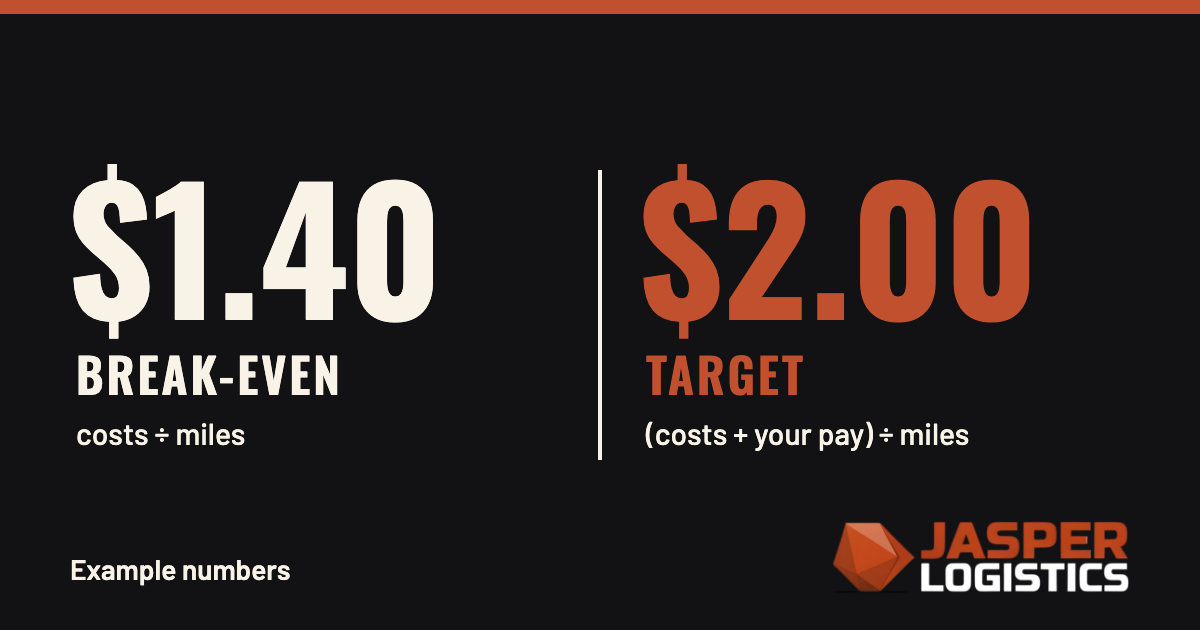
- Break-even cost per mile — what it costs to keep the truck running for one mile. Book below this and you lose money on every mile.
- Target rate per mile — break-even plus what you need to pay yourself. This is the number a load has to beat for the week to be worth driving.
The difference between them is your income. If you only track break-even, you'll fill the truck with loads that cover the payment and leave you working for free.
Step 1: List every monthly cost
Go through your statements and put every cost into a monthly figure. Annual bills get divided by 12. Typical lines:
Equipment
- Truck payment (each truck you pay on)
- Trailer payment
- Insurance — liability, cargo, physical damage. If one policy covers everything, count it once.
Running costs
- Fuel: monthly miles ÷ your real MPG × the price you actually paid per gallon
- Maintenance reserve: money set aside every month, including months when nothing broke
- Tires
- Tolls and scales
Fixed costs
- Permits, plates, IRP and any heavy-vehicle use tax (spread monthly)
- ELD subscription, load boards, software
- Phone, parking
- Accounting, factoring fees if you factor
- Dispatch fee if you use a dispatcher
Fill in as many lines as you can. Every missing line makes the result look better than reality, which is exactly the wrong direction to be wrong in. If you're unsure of a figure, estimate it high and correct it next month.
Step 2: Count the miles you actually run
Divide by all the miles the truck turns in a typical month — loaded and empty. Empty miles burn the same fuel and wear as loaded ones. Dividing by loaded miles only makes every number on the page look healthier than your bank account.
Use an ordinary month, not your best one.
Step 3: Work out your break-even
Break-even cost per mile = total monthly costs (without your pay) ÷ total monthly miles
Step 4: Add your pay to get your target rate
Decide what you need to take home each month. Add it to your costs:
Target rate per mile = (total monthly costs + your monthly pay) ÷ total monthly miles
This is your floor. A load that pays less than your target across all its miles — including the empty run to pick it up — is a load that pays you less than you decided you need.
A worked example
These numbers are an example, not a real client and not an industry average.
| Line | Monthly |
|---|---|
| Truck payment | $2,600 |
| Trailer payment | $800 |
| Insurance | $1,500 |
| Fuel | $6,200 |
| Maintenance & tires reserve | $1,200 |
| Permits, plates, ELD, phone, parking, software | $700 |
| Dispatch fee (example only; not Jasper's rate) | $1,000 |
| Total costs | $14,000 |
| Your pay | $6,000 |
| Total with pay | $20,000 |
| Miles run (loaded + empty) | 10,000 |
- Break-even: $14,000 ÷ 10,000 = $1.40 per mile
- Target: $20,000 ÷ 10,000 = $2.00 per mile
Now take a load paying $2,100 for 900 loaded miles, with 150 empty miles to reach the pickup. On loaded miles it looks like $2.33. Across all 1,050 miles it's $2.00 — exactly the target, not comfortably above it.
Keep it current
Your cost per mile moves when fuel, insurance or your truck payment moves. Re-run it whenever one of those changes, and at least once a quarter. The first time takes 15 minutes; updating it takes five.
How we use it at Jasper
We start with this calculation on the first call, line by line, from your own spending. It becomes your rate floor, and we book against it. You keep the worksheet whether or not you work with us.
If you'd like to build yours with a dispatcher, the call is 15 minutes and free: book a time. And if you're comparing dispatchers, here's what truck dispatchers charge and what the fee should cover.
Common questions
Should I include my dispatch fee in my costs?
Yes. It's a cost of running the truck like any other. Including it means your target rate already pays for it.
What if I don't know my real MPG?
Divide the miles from your last few fuel stops by the gallons you bought. That's more accurate than any spec sheet.
Should my pay go into break-even?
No. Keep it separate so you can see both numbers. Break-even tells you when you're losing money; target tells you when you're earning what you need.
How often should I recalculate?
Whenever a major cost changes, and at least every three months.