
Owner-operator guide · Deadhead miles
Deadhead Miles: How Empty Miles Change Your Real Rate Per Mile
The load board shows a rate per mile based on loaded miles. Your truck doesn't care whether the trailer is full. It burns fuel, wears tires and pays its note on every mile — loaded or empty. That's why a load can look like one of your best on the board and turn out to be one of your worst on the settlement.
What deadhead means
Deadhead is driving with no paying freight: usually the empty run to a pickup, and sometimes the run home after a delivery. No revenue comes in on those miles, but the truck's costs keep running.
The two empty legs
Every load has up to two empty legs worth counting:
- To the pickup. From wherever the truck is — your last delivery, or home — to the shipper.
- Home afterwards. If you're heading back to base instead of taking another load, that run belongs to the load that left you there.
The first is almost always there. The second only counts when you actually go home after the load, but when you do, it's real cost with no revenue against it.
Your all-in rate per mile
All-in rate per mile = load pay ÷ (loaded miles + empty miles to pickup + empty miles home, if going home)
That's the number to compare against your target rate per mile. If you haven't worked out your target yet, start with how to calculate your cost per mile.
Worked examples
These are example numbers, not a real load or client.
Example 1 — same load, different starting point
| Loaded miles | Empty to pickup | Total miles | Pay | Rate per mile | |
|---|---|---|---|---|---|
| Board view | 500 | — | 500 | $2,000 | $4.00 |
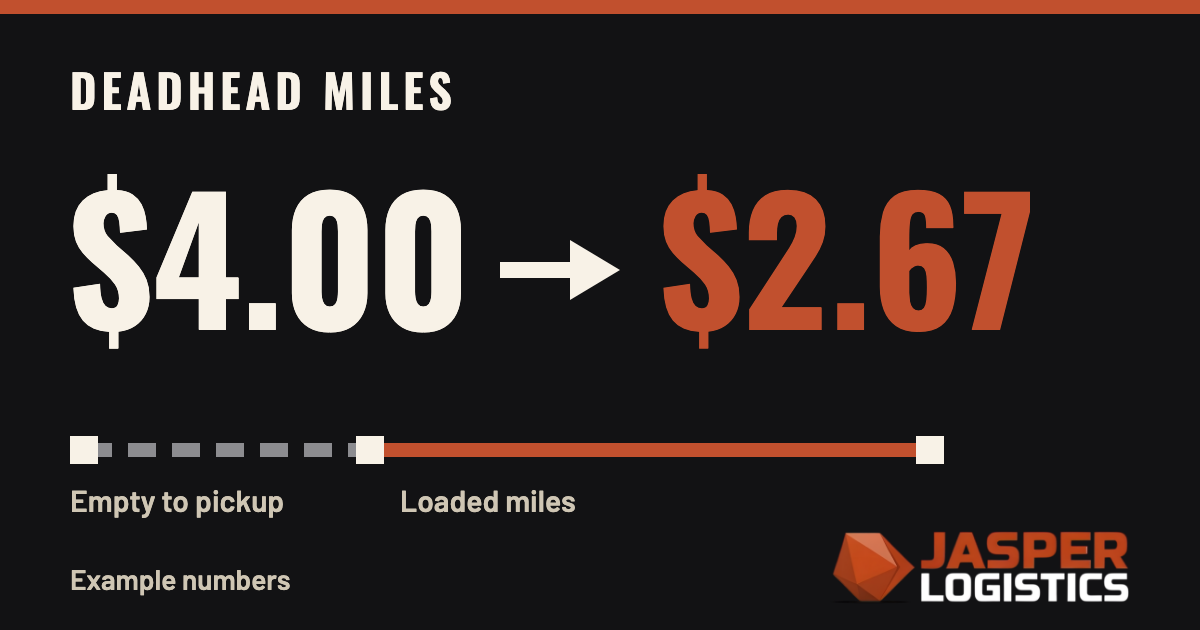
| Truck 250 mi away | 500 | 250 | 750 | $2,000 | $2.67 |
| Truck 500 mi away | 500 | 500 | 1,000 | $2,000 | $2.00 |
Same load, same broker. The only thing that changed is where your truck was.
Example 2 — the run home
A $1,800 load, 600 loaded miles, 100 empty to the pickup. All-in so far: $1,800 ÷ 700 = $2.57.
If you then drive 300 miles home empty: $1,800 ÷ 1,000 = $1.80.
If your target is $2.00, the first version clears it and the second doesn't. Whether you go home afterwards changes whether the load paid you.
Deadhead percentage
Deadhead % = empty miles ÷ total miles × 100
In Example 1, the truck 250 miles away runs 250 ÷ 750 = 33% empty on that load. Tracked week by week, this is one of the clearest signs of whether loads are being planned as a route or picked one at a time.
Comparing a load with your target
Before accepting, work out three things:
- The all-in miles: loaded + empty to pickup (+ home, if that's the plan).
- The all-in rate per mile.
- The difference from your target rate per mile.
A load above target on all-in miles is worth considering. A load that's only above target on loaded miles is a load the board is flattering.
Planning loads as a route
Deadhead is rarely zero, but it can be planned. The question isn't only "what does this load pay?" but "where does it leave me, and what's the next load out of there?" A slightly lower rate into a strong market can beat a higher rate into a dead end that costs 400 empty miles to escape.
That's how we work at Jasper: we plan loads as a route to raise the paid-mile share, and the weekly report is one page showing gross, loaded and empty miles, deadhead percentage and your average rate per mile against target.
If you want your target worked out and checked against real loads, the call is 15 minutes and free: book a time.
Common questions
Is deadhead ever paid?
Sometimes a broker pays extra to reposition a truck, but most of the time empty miles carry no revenue. Treat them as unpaid unless it's on the rate confirmation.
Should I count the run home on every load?
Only when you actually go home empty after that load. If you take another load instead, the next load's empty leg starts from where this one delivered.
What's a good deadhead percentage?
It depends on your lanes, equipment and home-time needs. Track your own weekly and watch the trend rather than chasing a general number.